

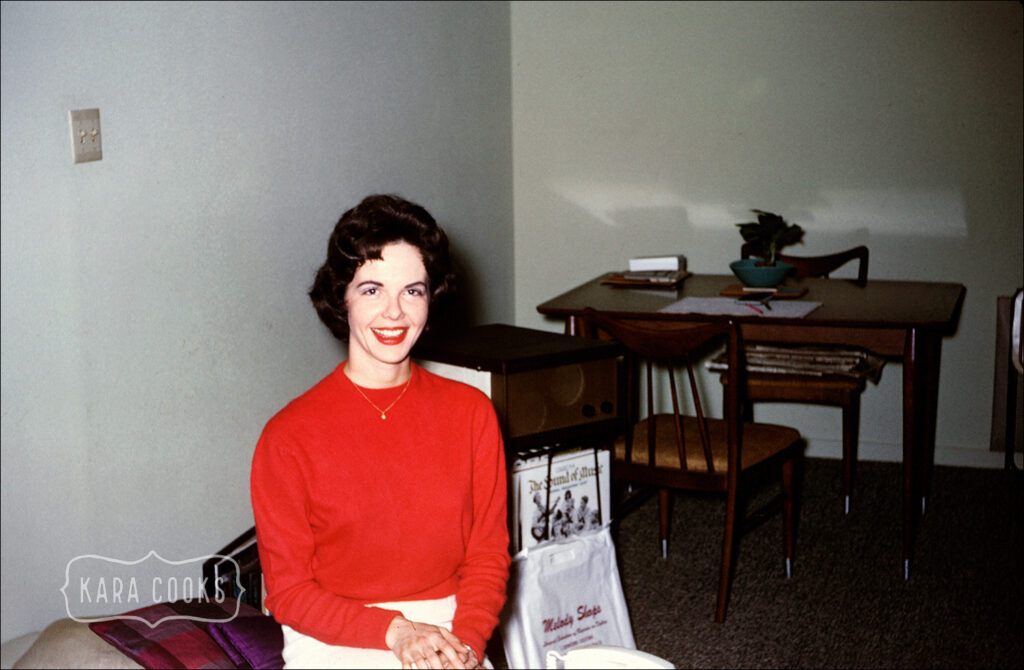
My mother, Carol Agnes McAuliffe, would have been 89 today, January 21st. She died in April 1999 at 62. She missed the year 2000 by nine months. She was so excited to see the turn of the millennium, and she never made it. That hurt for a long time.
I think about her this time of year. I think about her in April. And I think about her every time I try something new in the kitchen, every time I jury-rig a solution with whatever’s on hand, every time I decide that today’s the day I’m finally going to figure out how to make that thing I ate once at a restaurant seven years ago.
Not a Day-to-Day Cook
Carol was not a day-to-day cook. She could do it; she fed us, we didn’t starve. But the weeknight rotation of the same seven meals made her want to scream. Pan-fried hamburger patties, boxed mac and cheese, frozen vegetables. Spaghetti with meat sauce and an iceberg salad with bottled dressing. Meatloaf, box mashed potatoes, and steamed broccoli. Nutritious, filling, but boring.
What she loved was the new restaurant, the recipe she’d never tried before, the technique she’d read about in a magazine.
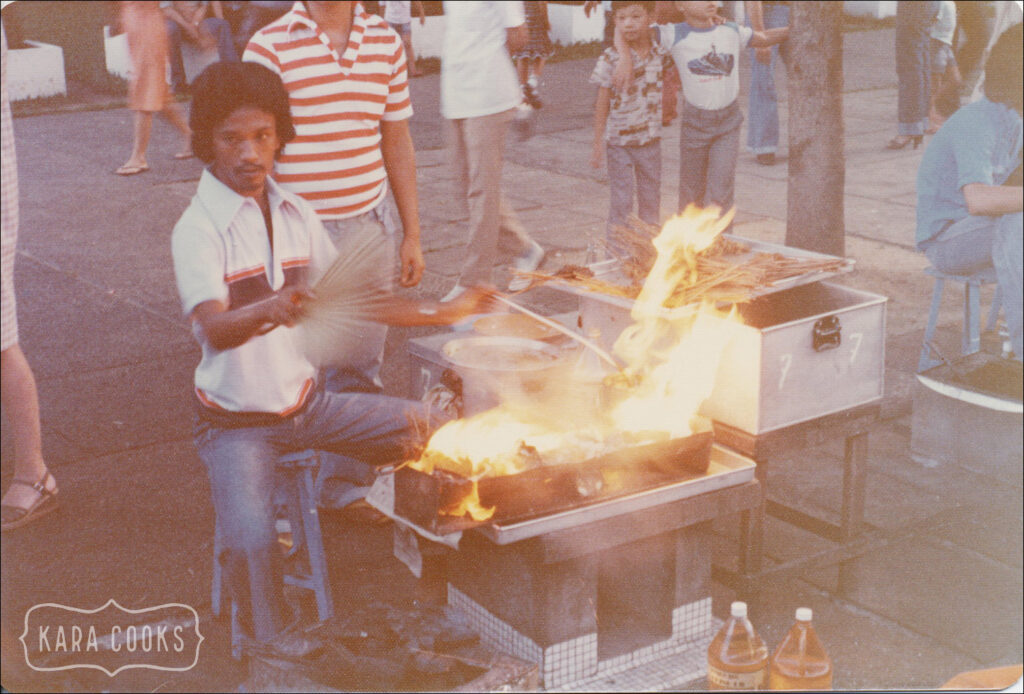
When we lived in Singapore from 1976 to 1979, she threw herself into learning how to cook local foods. Not the watered-down expat versions, the real stuff. She wanted to know how the aunties at the hawker stalls made their laksa, what made the satay from the little Hibachi grills at Merlion Park so much better than everywhere else.
She learned to make Nasi Lemak and Kari Ayam (my favorite). She made excellent Beef Rendang, but she was never quite happy with it. Everyone else loved it. She always wanted to learn to make chili crab, but she couldn’t bring herself to cook live crabs.
She was fearless in a way I didn’t fully appreciate until I was older and realized that most people don’t just decide to teach themselves Singaporean cooking in the pre-internet era through sheer force of will and library cards.
The Recipe Clippings
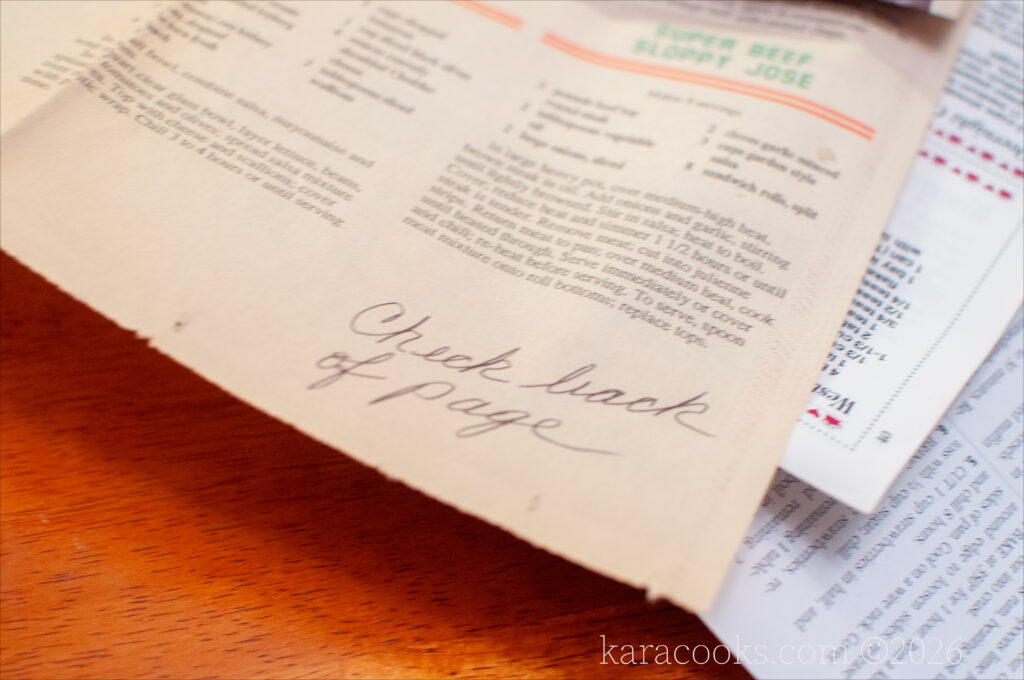
When I moved away from home in 1985, the recipe clippings started arriving. She subscribed to all the food magazines: Food & Wine, Gourmet, Martha Stewart Living, Southern Living. She religiously read the Food & Taste section of the newspaper.
At first the clippings were student-friendly: cheap, fast, impossible to screw up. “Thought you might like this!” she’d write on a yellow Post-it note stuck to a magazine page about one-pot pasta or how to make a week’s worth of burritos for under ten dollars. But as I got older and started my career and she saw me actually cooking, not just surviving, the clippings got more ambitious. Longer ingredient lists. More complicated techniques. Weird experimental things she’d found in Bon Appétit or Gourmet.
It was like she was watching me level up from a distance, sending me the next challenge when she thought I was ready.
This went on for fourteen years, until she died. After I left for college, she and my father ate pretty simply since it was just the two of them. But she loved to hear about me holding dinner parties, inviting friends over, cooking new things. And then the clippings would arrive; sometimes tailored to what she’d heard I was interested in and sometimes completely random with a direction to “Try this!” on them in her distinctive handwriting.
The Christmas Kitchen Appliances
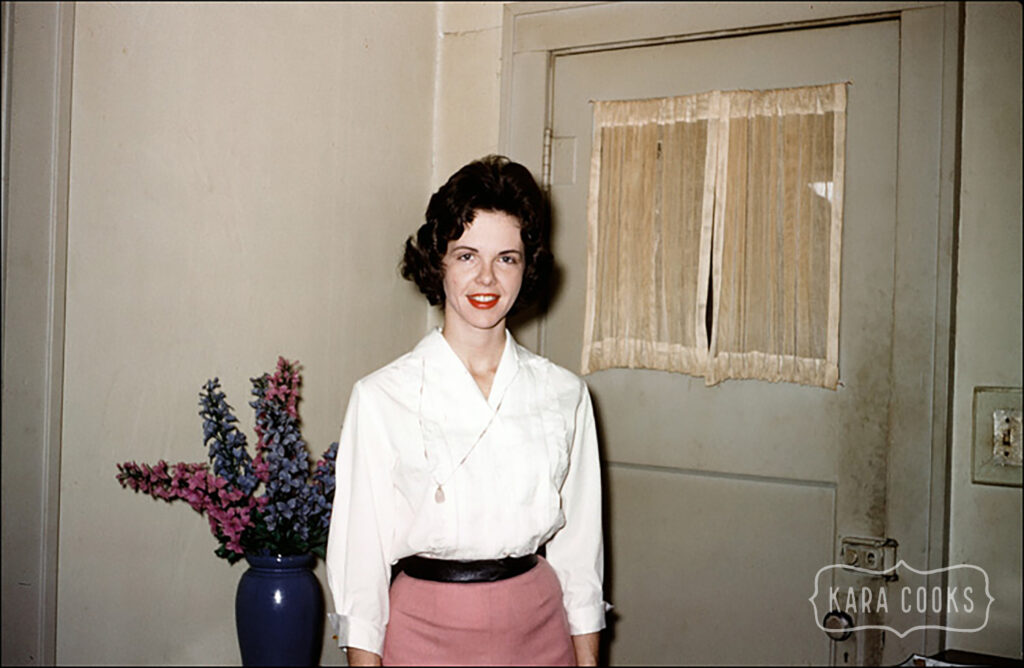
Every Christmas brought a kitchen appliance gift under the tree. In later years when I lived on the other side of the country she’d send me a check with specific instructions on what it should be used to buy. (I always bought what she told me to buy!) Sometimes it was something I’d mentioned wanting. More often it was something new and “cool” that she’d seen on TV or read about in a magazine.
Over the years I got (among many others that I can’t remember):
- A pasta maker that mixed, kneaded, and extruded the dough (it never quite worked right and I always ended up kneading by hand anyway)
- Two bread machines at different times – one that made weird round loaves that looked like they’d been baked in a coffee can and one that made good sandwich style loaves
- A combination steamer rice cooker that I actually loved and then lost in a move around 2004 and still miss
- Two fondue pots – one electric, one that used sterno
- A set of steam trays
- A Fry Daddy deep fryer
- My first mini food processor
- A juicer for making homemade fruit and vegetable juice – a 6 oz glass of “V8” required so many vegetables I gave up after three attempts
- A citrus juice press that I still have and use to make limoncello every year (recipe to come)
She never asked if I needed these things. She just thought they were interesting, thought I might have fun with them, thought maybe this would be the year I got really into fresh pasta or fondue or juicing.
About half of them were disasters or occasional-use items at best, but that wasn’t the point. The point was possibility. The point was: here’s another way to play in the kitchen.
The Laughter
Mom had the best laugh. Full throated. Contagious. A laugh that started as a giggle and escalated quickly.
We used to laugh together over things no one else understood. Something would strike one of us as funny and we’d start laughing. We’d laugh until we cried, wipe tears, and then one of us would catch the other’s eye and we’d start up again. My father and brother would just shake their heads and leave the room. They didn’t get it. They didn’t need to.
That was us.
The Typewriter Rice Story
Here’s the story that captures everything about how Carol cooked.
We’d moved back to Austin from Singapore in 1979, and she wanted to recreate the satay we used to buy from the street vendors at Merlion Park. No internet. No easy or cheap way to call someone in Singapore and ask for help. Just her determination, the cookbooks she’d brought back, and the Austin Public Library.
She found recipes, cross-referenced them, figured out the spice blend for the marinade. Made the chicken skewers. Made the peanut sauce. Made the pickled cucumbers.
But she needed the little sticky rice squares that came with it (ketupat, though we didn’t know that’s what it was called at the time). She found the right rice, cooked it properly, but then hit the problem: you’re supposed to wrap it in banana leaves and compress it under weight while it cools so it forms a tight, sliceable block. She didn’t have the traditional mold or the banana leaves or anything remotely appropriate.
She spread the rice in a 9×13 pan, covered it with a damp dishtowel, and set her IBM Selectric typewriter on top of it.
If you’ve never seen a Selectric, you might not understand. These things weighed about 45 pounds. They were the tanks of the typewriter world. And there was my mother’s, sitting on top of a pan of rice in the kitchen, doing exactly what it needed to do.
She served that satay to guests. They never knew. It worked perfectly.
And from that day forward, every time she made it (and she made it often over the next few years), we called it “typewriter rice.” Every time, she used the typewriter. It worked, why change it?
That was Carol. She wanted to make the thing; she figured out how to make the thing. And if the traditional equipment wasn’t available, well, she’d use what she had. The IBM Selectric was just sitting there on the desk, wasn’t it? It was heavy. It would do the job. Why overthink it?
What She Taught Me
I learned to cook family recipes from Meemaw, my Texas grandmother who taught me that there’s a right way to make biscuits and cornbread and chicken-fried steak, and that tradition matters.
But I learned to be bold in the kitchen from my mother. I learned that cooking is supposed to be interesting, that it’s okay to try things you don’t know how to make, that sometimes you just have to improvise with what you’ve got.
Every time I try a new technique I’ve never attempted before, every time I decide to just wing it and see what happens, every time I use something in a way it was definitely not intended to be used, I’m channeling Carol.
She would have loved the Kamado Joe. She was nervous about computers, but she would have absolutely lost her mind over the internet and YouTube cooking videos and the ability to just search for any recipe you want at any time. She would have sent me so many links!
I miss her. I miss laughing with her. I miss the recipe clippings that would randomly show up in the mail, tagged with a yellow Post-It note in her handwriting exclaiming “Must make this!” I miss the crazy kitchen appliances that I unwrapped every Christmas. I miss the way she approached food like it was an adventure.
Happy birthday, Mom. I’m making something new this week in your honor. Not sure what yet, but I’ll figure it out as I go. With the blog restarting, it seems right to honor you this way.
You taught me that.
What did your mother (or father, or whoever raised you) teach you about cooking? What do you wish you could cook with them one more time? Let me know in the comments.
P.S. If anyone has a lead on a combination steamer rice cooker from the late ’80s/early ’90s, I’m still looking for a replacement. That thing was perfect.
P.P.S. I’m told that Merlion Park in Singapore no longer hosts hawkers and vendors. They’ve been moved to a new food court nearby and the park has been “cleaned up” for tourists. I think it’s a cultural loss, but that’s progress I guess.
P.P.P.S. The typewriter rice actually worked better than it had any right to. Sometimes the ridiculous solution is the right solution.
P.P.P.P.S. I still have that citrus press. It’s older than some of my friends’ children and it works perfectly. Buy good tools, y’all.
I loved reading about your mom and I now see where your love of experimenting with food comes from. Beautiful! I don’t cook and I’m okay with that. I was the youngest of 3 girls so my mom taught my sisters the basics and I was sent to help my dad fix the car, prime the pump, etc. The one bit of cooking my mom did share with me was her love of cakes and pies. She rarely did anything fancy, mostly box cakes and premade pie crusts, etc. My mom and I had a “sweet tooth” and neither of us could wait for a freshly baked cake to cool long enough to frost it. One evening she made a standard box yellow cake. I was salivating as I smelled it cooking. I popped into the kitchen only minutes after she pulled it from the oven. I begged her to frost it right away and let me have a piece. She said the frosting would melt and slide right off. Seeing my disappointment, she said, “well, there is one thing we could do.” And she pulled butter from the fridge, cut a wedge from one of the cake pans, slathered it with the butter and we both devoured the warm moist, buttery, sweet wedges of plain old yellow cake. It tasted better than the overly sweet frosted version. Til this day, I can still taste it in my mind and my mouth waters. FYI, she cut the other cake layer in half, layered it and frosted it and served it on the table without explanation for the 1/2 cake. It wasn’t needed. Rarely did we have a fully intact pie or cake in our home. She even gave a 1/2 German Chocolate cake to the Church cake sale because it came out so good, we all needed to try it. Imagine my husband’s surprise to my mom’ arriving atThanksgiving, pie in hand (missing 1/4 of it) and not one member of my family batting an eye over it. So, I didn’t learn much about cooking from my mom but I did learn to enjoy food and not offer excuses for that indulgence. Thanks for sharing the story of you and your mom’s cooking adventures!
Thank you for reading and commenting, Tammy! I love that you know my mom just a little bit through my post. She was an amazing woman and you remind me of her in so many ways.